 Mendifinance
Mendifinance withdrawals after sunset follow separate lending and staking exit conditions
Mendifinance withdrawals after sunset depend on lending or staking release conditions, whether using the temporary interface or direct smart-contract access. The retired protocol operated on Linea, where existing lending and staking positions required different exit actions. Interface availability, collateral requirements and any staking release condition affected whether a particular withdrawal could proceed.
· last updated
Jump to a section
The short version: Outstanding borrowing could restrict collateral withdrawals even while the temporary withdrawal interface remained accessible.
Temporary interface access and position-specific limits
The sunset arrangements limited the withdrawal interface's availability, while lending and staking contracts imposed their own conditions on releasing assets. A reachable interface did not establish that a particular balance could be withdrawn. The selected position still determined which operation could release its balance.
The interface availability window
The withdrawal UI was designated to remain available for a limited period. The notice stated no calendar deadline, so it supplied no date from which to calculate remaining access. Check whether the withdrawal controls are actually usable before planning an interface-based exit.
The conditions attached to each position
Lending redemptions depended on market cash and, for collateral positions, the account's borrowing requirements. Staking used a pending-withdrawal arrangement with a release time. These conditions belonged to the respective contracts; closing the interface would not itself make a blocked withdrawal eligible.
Lending balances, debt and staked MENDI
The balance selected for withdrawal belonged to a specific lending market or staking arrangement, and each exit affected a different part of the account.
Supplied assets belonged to lending markets, while an outstanding loan represented an obligation to return borrowed assets with interest. Repaying debt and withdrawing supplied collateral moved assets in opposite directions. MENDI staking had separate Unstake and Withdraw controls, alongside reward-claim controls. Identifying whether the remaining balance was supplied capital, debt, staked MENDI or pending MENDI kept the first action tied to the position that needed attention.
Wallet readiness before the first exit transaction
Before a first exit transaction, establish the position-holding address on Linea and the contract that held the selected balance.
Read-only account checks leave the position unchanged. Match the lending market or staking contract to the existing position, then inspect its account balances. Keep token identifiers separate from display names: the underlying asset and its market receipt token represent different objects. Stop before signing if the selected contract, network or account does not match the intended position.
A standard wallet-paid Linea transaction needs ETH for network fees. That fee balance is separate from supplied assets or staked MENDI. Use the estimate for the proposed action, since repayment, redemption and staking withdrawal execute different contract functions. An estimated network fee does not establish a protocol withdrawal charge.
Review any spending approval before authorizing it. ERC-20 debt repayment used the borrowed asset and required the lending contract to receive that asset from the payer. An approval authorized spending; it did not settle debt or release collateral. A withdrawal interface also had no reason to receive the wallet's recovery phrase or private key.
How did a lending redemption release supplied assets?
The ERC-20 lending implementation redeemed market receipt tokens for the underlying asset, with different input units for its redemption methods.
Receipt-token amounts and underlying-asset amounts
redeem
accepted a receipt-token amount, while
redeemUnderlying
accepted an underlying-asset amount. The exchange rate connected the quantities, and each token's decimal precision governed its raw units. Identify the method and unit before entering a contract argument; a displayed supply balance cannot simply be copied into either field.
Market cash and remaining collateral
The lending implementation reverted a redemption if the market lacked enough underlying cash for the requested amount. For a market included in the account's collateral calculation, the lending controller rejected a redemption that would create a collateral shortfall. Borrow balances, collateral factors and oracle prices contributed to that calculation. A smaller redemption or debt repayment could address a collateral constraint, while insufficient market cash required its own recheck. Direct contract access preserved these limits.
Unstaking and withdrawing pending MENDI
Unstaking reduced the sMendi balance and recorded pending MENDI, while withdrawal released the pending amount after its timing condition. The staking withdrawal function required the account's recorded release time to have arrived before releasing its pending amount. The pending period was configurable, so use the account's release timestamp rather than treating an earlier duration as permanent. A pending amount described an unfinished exit, even if the corresponding staked balance had already fallen.
A blocked redemption changed the first action
In this hypothetical case, repayment was the available preparatory action when a proposed collateral redemption failed its borrowing constraint.
Assume the position-holding Linea account has an outstanding loan and enough of the borrowed asset to make a partial repayment. Its selected market has sufficient cash, and the repayment allowance is ready. The reader expects the supplied balance to be withdrawable, but a preflight check shows that the proposed redemption would create a collateral shortfall.
At that state, the redemption would fail the collateral check. The reader instead submits the prepared partial repayment. For this example, assume it executes successfully: the market first accrues interest, then reduces the debt by the amount received. The supplied collateral remains in place, because repayment did not redeem it.
Before submitting a redemption, recheck the revised account constraint and market cash. If the proposed amount remains blocked, stop there; the successful repayment does not authorize every subsequent withdrawal amount.
Transaction records and balances that showed completion
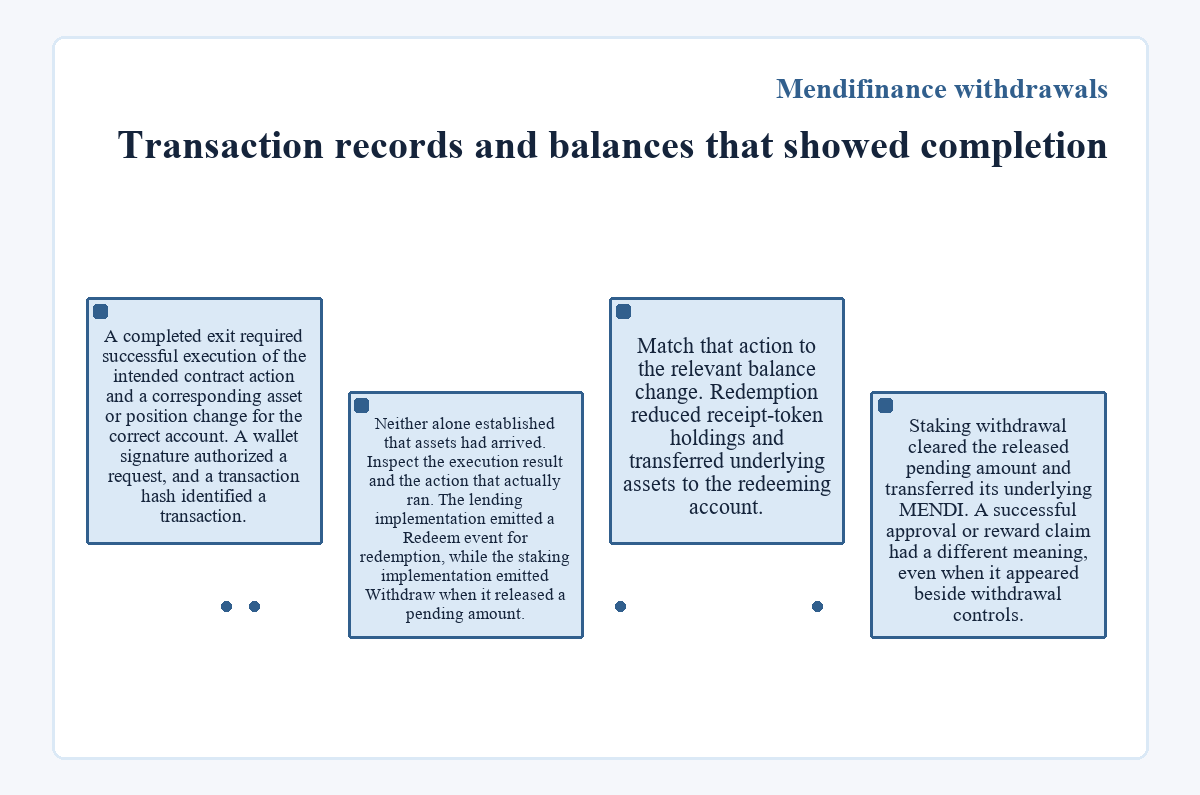
A completed exit required successful execution of the intended contract action and a corresponding asset or position change for the correct account.
A wallet signature authorized a request, and a transaction hash identified a transaction. Neither alone established that assets had arrived. Inspect the execution result and the action that actually ran. The lending implementation emitted a Redeem event for redemption, while the staking implementation emitted Withdraw when it released a pending amount.
Match that action to the relevant balance change. Redemption reduced receipt-token holdings and transferred underlying assets to the redeeming account. Staking withdrawal cleared the released pending amount and transferred its underlying MENDI. A successful approval or reward claim had a different meaning, even when it appeared beside withdrawal controls.
Contract access after UI closure and later transfers
The sunset arrangements named smart-contract access after the temporary UI period, leaving the same position-specific requirements relevant to an exit. Direct interaction required the deployed contract address, its callable interface and correctly encoded arguments. A generic contract with a similar name was not a substitute for the contract holding the position.
Releasing assets on Linea and moving them to another network were different operations. Historical cross-chain deposits did not establish a reverse withdrawal route. Any later transfer had its own asset compatibility, availability and cost conditions; a completed protocol withdrawal established receipt on Linea, not arrival on another chain.
Details worth knowing about Mendifinance withdrawals
Is buying MENDI necessary before redeeming a supplied lending asset?
MENDI was not an input to the ERC-20 lending redemption functions. Those functions exchanged the account's market receipt tokens for that market's underlying asset. A standard wallet-paid transaction also needed ETH for Linea network fees. Holding the protocol token did not satisfy a market-cash or collateral requirement.
Does a zero balance on an unconnected staking screen prove that no position remains?
A display without account data could not establish whether a particular wallet had a remaining position. The selected address's staked balance and pending-withdrawal record answered different questions. A generic screen showing zeros, or showing data for another address, was insufficient to establish that the intended account had fully exited.
When could further unstaking change an earlier MENDI release time?
A further positive unstake in the staking implementation reset the release time for the accumulated pending amount. It added the new amount to the existing pending balance and assigned a timestamp using the configured pending period. That could postpone release of an earlier pending amount, so review the effect before initiating another unstake.
What did exitMarket change without redeeming supplied assets?
The lending controller's exitMarket function removed an eligible market from the account's collateral calculation without transferring its underlying assets. It required no outstanding borrowing in that market and checked whether the remaining collateral could support the account. Successful market exit and actual asset redemption were different results.
Can another account repay a loan before the borrower withdraws collateral?
The ERC-20 lending contracts included repayBorrowBehalf, which let a payer repay debt for a specified borrower. Repayment required the borrowed asset and an adequate spending allowance from the payer. It reduced the borrower's debt; it did not transfer the borrower's supplied collateral to the payer or perform a redemption.
Why could a stored account view differ from a redemption simulation?
Some account queries used stored borrowing balances and exchange rates, while redemption accrued interest before applying its checks. A transaction simulation could therefore evaluate a different state from an older account view. Its outcome also described the simulated state, so changing prices, debt or market cash could affect later execution.
Are network fees charged when a withdrawal transaction reverts?
An included transaction that reverted during execution could still incur a network fee for the computation it used. Its reverted withdrawal did not release the requested assets. A failed preflight simulation was different: without a submitted transaction, it did not create an onchain withdrawal or its transaction fee.